
Guides › What happens to food waste
What happens to your food waste?
The short answer
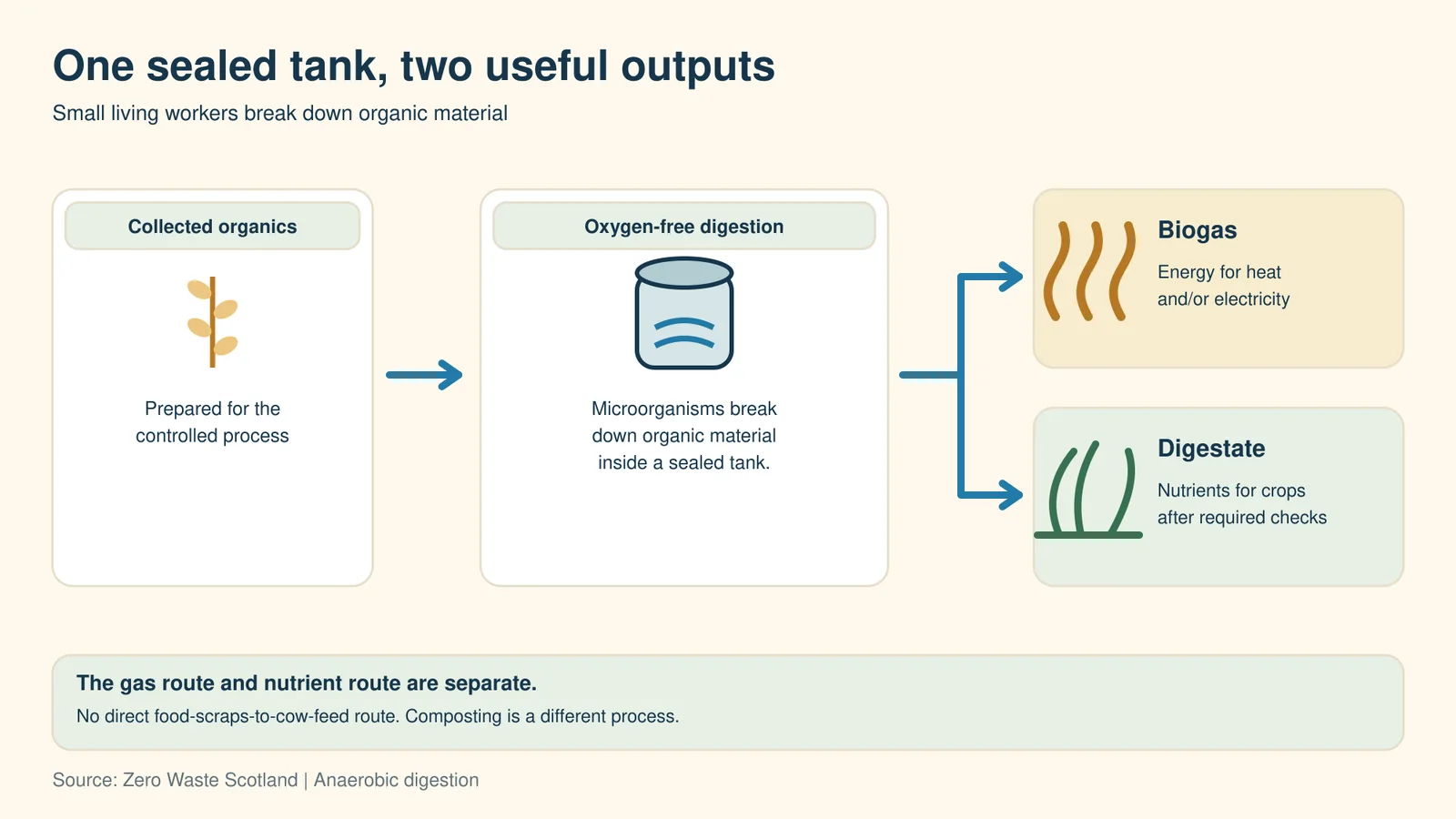
In most places, food scraps from your caddy go to an anaerobic digestion plant. In sealed tanks with no air, tiny living things break the food down. That makes two things: biogas, used for electricity, heat or fuel, and digestate, a fertiliser for farmland. Some councils compost food waste instead. Your council’s own page says which.
First: save the food that’s still good
The best food waste is the food that never becomes waste. UK households throw away about 6.0 million tonnes of food a year, and almost three quarters of it is food that could have been eaten. For a household of four, that edible food is worth around £1,000 a year (figures for 2022, WRAP, Food surplus and waste in the UK: key facts (July 2025)).
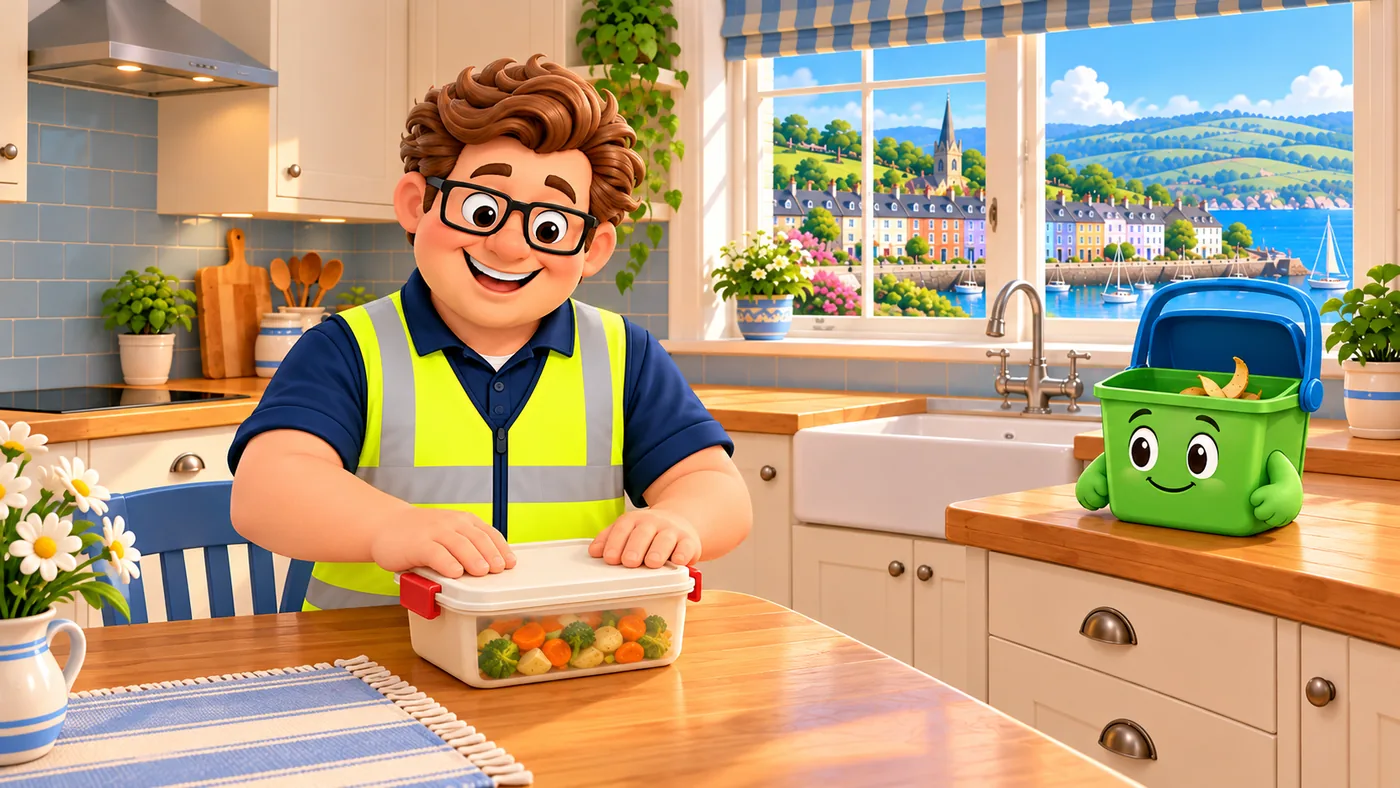
Our guide Save good food first has simple ways to plan, store and use up food. The caddy is for what’s left: peelings, cores, bones, tea bags and plate scrapings.
What goes in the caddy
Councils differ, so your council’s list always wins. As an example, East Cambridgeshire’s caddy takes cooked and uncooked food, including meat, bones, vegetables, fruit, tea bags, eggshells and coffee grounds, but not liquids or oil (East Cambridgeshire District Council, food waste).
In England, councils must collect food waste from homes every week. The rules started on 31 March 2026, with later dates for some councils that already had contracts in place (GOV.UK, Simpler Recycling: household recycling in England). Scotland, Wales and Northern Ireland have their own rules. Find your council’s page to see what yours collects.
The journey, step by step
- Collected. The caddy goes into its own lorry, or its own part of one, so food doesn’t mix with recycling or rubbish.
- Prepared. At the plant, the food is mixed into a thick, soupy liquid. Plants usually take out anything that isn’t food first, which is why the right liners matter.
- Digested. The mixture goes into a sealed tank with no oxygen. Microbes break it down. This is anaerobic digestion: “anaerobic” means without air.
- Two things come out. Biogas rises from the tank. What’s left at the bottom is digestate.
Biogas: energy from scraps
Biogas is mostly methane and carbon dioxide. It can be burned to make electricity and heat, or cleaned up into biomethane and put into the gas grid or used as vehicle fuel. In 2024, most UK biogas made electricity, and a smaller share went into the grid or became transport fuel (Green Alliance, Biogas in the UK explained (March 2026)).
Digestate: food for fields
Digestate is full of the nutrients plants need, so farmers spread it on fields as fertiliser instead of using fertiliser made from fossil fuels. It has to be used carefully, because too much can pollute land and water (Green Alliance, Biogas in the UK explained (March 2026)).
There is a safety rule too: animals can’t graze land, or be fed grass cut from it, until at least 21 days after this kind of fertiliser is spread (Animal by-products regulation 1069/2009, article 11 (legislation.gov.uk)).
Compost is not digestate
Some councils send food waste, often mixed with garden waste, to in-vessel composting instead. That happens with air: the material heats up to 60–70°C, which kills germs and weed seeds, and after several weeks of maturing it becomes compost for gardens, landscaping and farms (Zero Waste Scotland, What is in-vessel composting?). Composting makes compost, but no biogas.
Myths
“Scraps go to feed cows.”
No. Digestate feeds the soil, and the grass grows. Cows eat grass and proper feed, never kitchen scraps.
“My hens can have the leftovers.”
It’s against the law to feed kitchen scraps to farm animals, even pet pigs and backyard hens, because of the risk of diseases like African swine fever and foot and mouth (GOV.UK, APHA warns not to feed kitchen scraps to farm animals (2017)).
“It all ends up in landfill anyway.”
Not when it’s collected separately: that is the point of the caddy. Food in the general rubbish can’t go to a digester.
“Liners don’t matter.”
They do. Use the liners your council asks for, because the wrong bags have to be taken out at the plant.
Read it as a story
In Hamish’s short menu, Eddie the recycling lorry driver wonders whether Hamish the cow would like his potato peelings, and Amina shows him what really happens at the bio plant. For home or class, there’s a free food waste learning pack. Gullbrae is made up; the science is real.
Questions
Can tea bags go in the food caddy?
Many councils say yes; East Cambridgeshire, for example, lists them (East Cambridgeshire District Council, food waste). Some tea bags contain plastic, so check your council’s list.
Why not just put food in the rubbish bin?
Collected separately, food becomes energy and fertiliser. In the rubbish, it can’t.
Does my council collect food waste yet?
Enter your postcode and we’ll take you to your council’s own page.
Sources
- WRAP, Food surplus and waste in the UK: key facts (July 2025)
- GOV.UK, APHA warns not to feed kitchen scraps to farm animals (2017)
- Animal by-products regulation 1069/2009, article 11 (legislation.gov.uk)
- Green Alliance, Biogas in the UK explained (March 2026)
- Zero Waste Scotland, What is in-vessel composting?
- East Cambridgeshire District Council, food waste
- GOV.UK, Simpler Recycling: household recycling in England
Read on 17 October 2026. Not yet checked by an independent fact reviewer. Spotted a mistake? Tell us.